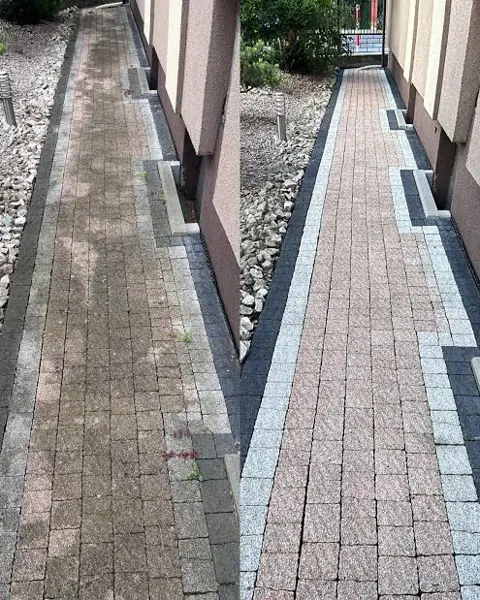
The Decision Tree: Clean, Restore or Replace Your Outdoor Surface
Work through the questions in order: does the surface move, has it sunk, are the cracks active, is the damage widespread, is the colour still there, and is the base sound? The first ‘yes’ to a structural question points away from restoration; if every structural answer is ‘no’, the choice is between a clean and a full restoration, and the colour decides it.
Send us a photo and the m²Why use a decision tree at all?
Because the order of the questions matters more than any single answer. It is tempting to start with the colour, since that is what bothers you, and only later discover a sinking corner that changes everything. Asking the structural questions first prevents that.
The tree also keeps the decision honest. It does not ask what you would like to hear; it asks what the surface is doing. That works whether you are standing on the drive yourself or looking at photos sent by your property manager.
Question 1: Does anything move when you walk or drive on it?
If any slab, paver or section rocks, clicks or shifts underfoot, stop here: the support underneath has gone. Restoring the surface would put new colour on something that is still moving.
A loose paver or two at the edge of a path may be a local fix for a builder. Large areas that move point to bedding or ground problems that need proper assessment.
Question 2: Has any area sunk, or does water now pool where it used to drain?
A ‘yes’ means settlement. Crouch at one end of the drive and look along it at a low angle: dips that were not there before, or puddles after rain where water once ran away, both indicate that the ground has changed.
Settlement has a cause, such as washout, a leak, poor compaction or roots, and that cause has to be found and solved. Structural work is not part of our service, so at this point the next call is to a builder or engineer.
Question 3: Are any cracks stepped, wide or growing?
Look for three things: one side of a crack higher than the other, a gap wide enough to take a finger, and a crack that is visibly longer or wider than at your last visit. Any of these suggests active movement.
Fine, flat hairline cracks are a different story. They are normal in concrete and can be filled during a restoration. Our guide to defects and their causes has photos and explanations of both kinds.
Question 4: Is the damage widespread or local?
Restoration handles local damage well: a chipped edge here, a small pothole there, a spalled patch by the drain. When the surface is broken through across large areas, it has failed rather than aged, and replacement is usually more realistic.
There is no fixed threshold, and we will not invent one. The question is whether, once the damaged parts are repaired, what remains is a sound, continuous surface. Photos of the whole area make this easy to judge.
Question 5: Is the colour still there under the dirt?
If you have reached this question, the base is sound. Now the choice is between a clean and a full restoration, and the colour decides it.
Hose a small patch hard, or ask someone to scrub one with water. If it comes up close to the original colour, a professional wash may be enough. If it comes up pale, chalky or patchy, the colour itself has worn away, and only recolouring will bring back an even tone.
Question 6: Do you want the surface renewed, or simply clean?
Even when cleaning would be acceptable, some owners want more: a different, deeper colour, crisp edges and one consistent tone across drive, carport and terrace. That is a restoration by choice rather than by necessity, and it is a perfectly reasonable one.
If you choose to restore, the work follows our usual sequence of washing, repairs, edging and two coats. The details are on our patio refresh service page, and the trade-offs are summarised on clean, restore or replace.
How does the tree work for communities and rentals?
The questions are identical; who answers them changes. In a community of owners, the administrador or president usually gathers the photos and the answers before the Junta discusses the work. Our communal surfaces page explains how that fits the LPH.
For a rental villa, the timing adds a seventh question: when is the property free? That shapes when the work can happen rather than what work is needed. The article on who restoration suits looks at different owner situations.
What should you send us after working through the tree?
Your answers plus the photos that support them: a wide shot, a low-angle shot along the surface, close-ups of cracks with something for scale and the patch you tested for colour. Add the approximate square metres.
We will check your conclusions and tell you honestly whether restoration fits. If it does not, we will say so, because replacement is not work we do.
Frequently asked questions
What is the first thing to check before restoring a driveway?
Whether anything moves. Walk and, where possible, drive over the whole surface and watch and listen for slabs or pavers that rock or click. Movement means the support underneath has failed, and that must be solved before any surface work is worth doing.
How can I tell if my driveway has sunk?
Crouch at one end and look along the surface at a low angle. Dips and humps show up clearly. Also check where water collects after rain or hosing; new puddles in places that used to drain are a reliable sign of settlement.
How do I know whether a crack is active?
Mark both ends with a pencil line and the date, then check again on a later visit, or ask your property manager to. If the crack has grown past the marks, it is active. Stepped cracks, where one side is higher, also suggest movement.
Is there a simple test to choose between cleaning and restoring?
Clean a small patch thoroughly with water and a brush. If the original colour comes back, a professional clean may be enough. If the patch looks pale, chalky or uneven even when clean, the colour has worn off, and a recolour is needed for an even finish.
Can I restore part of a driveway and replace another part?
Yes, as long as the replacement is done first by a contractor who lays concrete or paving. Once the new section is ready for coating according to the product data sheet, the whole area can be restored so that old and new match visually.
What if I answer yes to a structural question?
Then the cause has to be investigated before any restoration. Depending on the problem, that may be a builder, an engineer, a drainage specialist or a tree surgeon. Structural work is outside our service, but once the base is stable we can assess the surface again.
Does the decision tree work for stamped concrete?
Yes. The questions apply to plain concrete, stamped concrete and block paving alike. With stamped concrete, also look at whether the pattern is still visible; a coating follows the texture, so a crisp pattern stays readable after restoration. Where it has worn flat, that will still show under the new colour.
Can my property manager answer the questions for me?
Yes. The checks are practical: walking the surface, looking along it, examining cracks and testing a patch. A property manager, gardener or neighbour can do them and send photos. We can then go through the answers with you in English.
Is restoring by choice, not necessity, a sensible decision?
Yes, if the base is sound. Some owners restore a surface that could merely be cleaned because they want a deeper colour, consistent tones across several areas or crisp edges. That is a legitimate aesthetic choice, not an upsell, and it follows the same process.
Will you disagree with my conclusion if the photos show otherwise?
Yes, politely. If your photos suggest movement or settlement you had not noticed, we will point it out. If they show that cleaning would be enough, we will say that too. The aim is the right solution for the surface, not the largest job.